
A Beginner’s Guide to Machine Vision
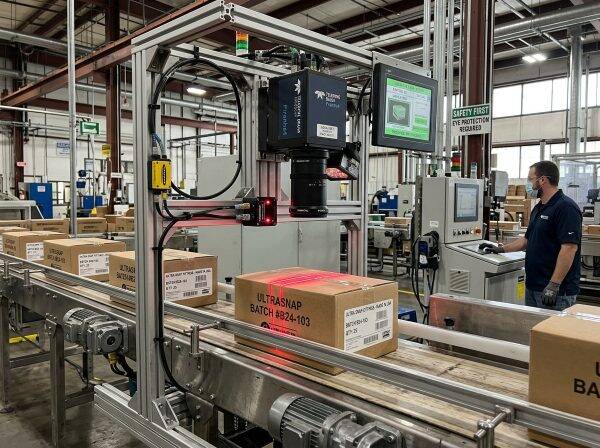
Machine vision is the technology that lets automated systems “see” the physical world — capturing images, analyzing them, and making decisions based on what they find.
Here’s a quick breakdown:
- What it does: Inspects, measures, identifies, and sorts parts or products using cameras and software
- Where it’s used: Manufacturing lines, logistics warehouses, robotics, pharmaceuticals, food processing
- How it works: A camera captures an image → software analyzes it → the system acts (pass, fail, sort, guide)
- Why it matters: Faster and more consistent than human inspection, with zero fatigue
Machine vision is one of the core technologies behind modern industrial automation. It’s been around since the 1970s — early systems could read simple barcodes but little else. Today, AI-powered systems can detect microscopic defects, guide robotic arms, and track every package in a warehouse in real time.
If you manage a production line, you’ve likely already felt the problems that machine vision solves: inconsistent quality checks, slow inspection bottlenecks, labeling errors, and the rising cost of manual labor.
This guide walks you through everything you need to know — from how these systems work, to where they deliver the most value on the factory floor.
At its heart, machine vision is a systems engineering discipline. It isn’t just a camera; it is the integration of hardware and software to provide imaging-based automatic inspection and robot guidance. As noted in the MIT course on machine vision, the field involves generating symbolic descriptions of an environment from images. In a factory setting, that “symbolic description” might simply be a “Pass” or “Fail” signal sent to a PLC (Programmable Logic Controller) to kick a defective vial off a conveyor belt.
Machine Vision vs. Computer Vision
While people often use these terms interchangeably, they serve different masters. Think of computer vision as the “brainy” academic sibling and machine vision as the practical, “blue-collar” worker on the factory floor.
Computer vision is a broad field of computer science focused on digital image processing and high-level understanding. It powers things like facial recognition on your smartphone or the algorithms used in medical research to identify patterns in X-rays.
In contrast, machine vision is specialized for industrial applications. It requires rugged hardware, real-time processing, and high-speed integration with physical machinery. While computer vision might try to “understand” a scene, machine vision is programmed to “execute” a specific task—like checking if a label is straight or if a bottle is filled to the correct level.
| Feature | Computer Vision | Machine Vision |
|---|---|---|
| Primary Goal | Image understanding & analysis | Industrial execution & control |
| Environment | Unstructured (the real world) | Structured (factory/warehouse) |
| Hardware | General purpose (PCs, mobile) | Specialized (Smart cameras, LEDs) |
| Processing | Asynchronous / Cloud | Real-time / Edge |
The Evolution of Imaging Technology
The journey of machine vision began in the early 1970s. These “classic” systems were quite limited; they could recognize simple text or 1D barcodes but struggled with handwriting or organic shapes. If a part was slightly rotated or the lighting changed, the system would often fail.
The technology has since exploded. We moved from simple 2D imaging to 3D triangulation, which uses lasers to create depth maps of objects. This allows robots to “see” volume and height, making tasks like random bin picking possible. Technologies like Intel RealSense technology have further pushed these boundaries, bringing advanced depth-sensing to industrial equipment. We are even seeing the rise of hyperspectral imaging, which can “see” chemical compositions or moisture levels that are invisible to the human eye.
Core Components and the Step-by-Step Process
A machine vision system is only as strong as its weakest link. For a system to work, it must follow a precise sequence of events:
- Image Capture: The camera and lens capture light reflected from the object.
- Preprocessing: The software cleans up the image, adjusting contrast or removing “noise.”
- Feature Extraction: The system looks for specific markers, such as edges, holes, or text.
- Pattern Recognition: The software compares these features against a “gold standard” or a trained model.
- Decision Making: The system issues a command (e.g., “reject part”).
To handle the heavy lifting of image processing, many developers rely on the OpenCV library, which contains over 2,500 optimized algorithms for real-time applications.
Essential Hardware for a Machine Vision System
You can’t just slap a webcam on a production line and expect it to work in a dusty factory in Biddeford, ME. Industrial machine vision requires specialized gear:
- Smart Cameras: These are self-contained units that include the sensor, processor, and software in one housing. They are great for simpler tasks.
- Industrial Lenses: Unlike consumer lenses, these are designed for precision and durability, often with fixed focal lengths to ensure consistent measurements.
- LED Lighting: This is perhaps the most underrated component. Dedicated lighting (ring lights, backlights, or strobes) ensures the camera sees the part with high contrast, regardless of the ambient light in the facility.
- Frame Grabbers & Industrial PCs: For complex tasks, a separate high-powered PC or a frame grabber card is used to process massive amounts of data at lightning speed.
Software and Algorithmic Processing
The “brains” of the system use various logic steps to interpret the pixels. According to scientific research on machine vision algorithms, traditional systems rely on rule-based logic. This includes:
- Filtering: Removing unwanted visual data.
- Thresholding: Converting a grayscale image to black and white to isolate parts.
- Edge Detection: Finding the boundaries of an object to measure its width or height.
- Blob Extraction: Identifying a group of connected pixels as a single object (like a stray drop of glue on a pharmaceutical package).
The Impact of AI and Deep Learning in Modern Systems
The biggest shift in recent years is the move from “rule-based” logic to AI-powered machine vision.
In a rule-based system, a programmer tells the computer: “If this line is more than 5mm long, it’s a defect.” But what if the defect is a subtle scratch on an organic surface, like a piece of fruit or a hand-welded joint? Rules struggle here.
Enter Deep Learning. By using neural networks, we can “train” a system by showing it thousands of images of “good” parts and “bad” parts. The system learns to recognize patterns on its own, much like a human does. This is particularly useful for identifying “organic” defects that vary in shape and size.
Research, such as the pioneering work on deep learning in vision, has shown that these systems can now rival or even exceed human accuracy in classification tasks. Furthermore, by utilizing edge computing, EAM can deploy these AI models directly on the factory floor, reducing latency and ensuring the system reacts in milliseconds without needing to send data to the cloud.
Industrial Applications and Key Benefits
Why are companies from Manchester, NH to Boston, MA investing in this? The benefits are measurable and immediate. As of 2006, the machine vision market in North America was already worth $1.5 billion, and it has only grown since.
The primary drivers are:
- Quality Control: Catching defects that a tired human eye might miss after eight hours on a shift.
- Waste Reduction: Identifying a process error early, like a misaligned labeler, before thousands of products are ruined.
- Labor Shortages: Filling the gap when skilled inspectors are hard to find.
- Compliance: In the pharmaceutical and medical industries, machine vision ensures that every vial has the correct label and safety seal, providing a digital trail for audits.
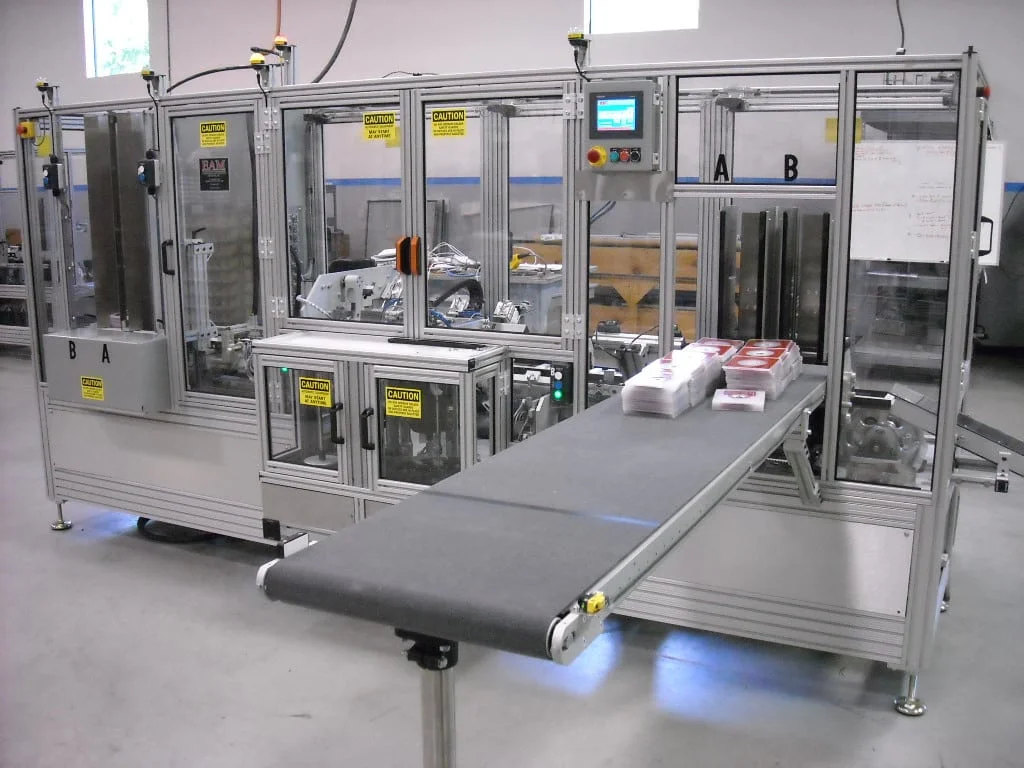
For manufacturers that need inspection equipment integrated into a larger automation process, EAM’s custom automation products can combine cameras, conveyors, controls, and handling systems into one production-ready solution.
Applications in Manufacturing and Robotics
In robotics, vision is the difference between a “dumb” arm that moves to a fixed point and a “smart” system that can adapt. Machine vision provides robot guidance, telling the arm exactly where a part is located and how it is oriented. This is critical for:
- Bin Picking: Selecting parts from a jumbled pile.
- Assembly Verification: Checking that every screw and component is in the right place.
- Sorting: Automatically directing different products to different lanes based on their appearance.
As explored in scientific research on robot vision, giving robots “sight” allows them to interact safely and intelligently with their environment.
Benefits for Supply Chain and Logistics
Logistics centers in places like Worcester and Portland use machine vision to keep the world moving.
- In-Motion Tracking: High-speed cameras read barcodes on packages as they fly down a conveyor belt at 10 feet per second.
- Label Integrity: Systems check that labels are present, legible, and correctly placed.
- Inventory Management: Automated systems can count stock on shelves or verify that a shipping container is packed to maximum efficiency.
Frequently Asked Questions about Machine Vision
What Are the Main Challenges in Deploying These Systems?
It isn’t always “plug and play.” The biggest challenges include:
- Environmental Lighting: Changes in sunlight from a nearby window can confuse a poorly designed system.
- Integration Complexity: Getting the camera to talk to the conveyor, the robot, and the company’s database requires expert engineering.
- AI Training: Deep learning models require high-quality data to be effective.
How Accurate Are Automated Inspection Systems?
Extremely. Accuracy is a function of camera resolution and software. By using sub-pixel interpolation, a system can often measure features much smaller than a single pixel. However, accuracy is also tied to the “Field of View”—a camera looking at a football field will be less accurate than one looking at a postage stamp.
What Is the Future Outlook for This Technology?
We are moving toward Industry 4.0, where every machine is connected via the Internet of Things (IoT). The future includes:
- Generative AI: Helping to create synthetic training data for AI models.
- Autonomous Robotics: Robots that can navigate complex warehouses without floor markings.
- Real-time Edge Processing: More power packed into smaller, smarter cameras.
Ready to Give Your Production Line Better Sight?
At Engineered Automation of Maine (EAM), we’ve spent over 30 years helping manufacturers in New England stay competitive. We don’t just sell cameras; we design and build the entire custom automation system — from the conveyors that move your product to the inspection tools that ensure every piece is perfect.
Whether you are in Sanford, ME or Nashua, NH, if you are looking to improve your efficiency and eliminate errors, explore EAM’s custom machine vision solutions to see how we can bring “sight” to your production line.