
Your Complete Guide to RFID Systems
RFID systems are wireless technology solutions that use radio waves to automatically identify and track objects, people, or assets — no line of sight required.
Here’s what you need to know at a glance:
| Feature | Details |
|---|---|
| What it stands for | Radio Frequency Identification |
| How it works | Radio waves transfer data between tags and readers |
| Key advantage over barcodes | Reads hundreds of tags simultaneously, no scanning needed |
| Main frequency bands | LF (125–134 kHz), HF (13.56 MHz), UHF (860–960 MHz) |
| Tag types | Passive, active, and semi-passive |
| Typical read range | Contact up to 10+ meters depending on frequency |
| Common uses | Manufacturing, logistics, retail, healthcare, asset tracking |
For manufacturing managers specifically, RFID means faster inventory counts, automated line tracking, and real-time visibility across your entire operation — without manual scanning or human intervention.
The technology has grown rapidly. In 2024, roughly 50 billion RFID tag chips were sold worldwide. The global market is expected to grow from $12.08 billion in 2020 to $16.23 billion by 2029. That growth reflects how deeply RFID has embedded itself in modern industrial operations.
This guide covers everything — how RFID works, the different types and frequencies, real-world manufacturing applications, security considerations, and how EAM can help you implement the right solution.
Understanding the Core Components of RFID Systems
To understand how RFID systems function, it is best to look at them as a specialized ecosystem of hardware and software working in harmony. Unlike a simple scanner, an RFID setup involves several distinct layers that ensure data moves accurately from a physical object to your enterprise resource planning (ERP) system.
The primary hardware components include:
- RFID tags (transponders): These are the “smart labels” attached to assets. A tag consists of an integrated circuit (IC), or chip, that stores data and a tiny antenna to transmit that data.
- RFID readers (interrogators): These devices emit radio waves to “wake up” the tags. They can be fixed, such as mounted on a conveyor or dock door, or handheld for manual inventory counts.
- Antennas: Readers use antennas to broadcast the signal. In many industrial RFID systems, the antenna is a separate component connected to the reader via a high-quality cable.
- Middleware: This is the “brain” of the operation. It filters the massive influx of raw RFID data, removes duplicate reads, and passes only the relevant information to your back-end software.
For teams that need these components to work as part of one seamless workflow, EAM’s RFID solutions show how RFID hardware can be tailored to specific industrial requirements.
Data Transmission and Standards
The way these components talk to each other is governed by strict protocols. The most common for industrial use is the EPC Gen 2 standard, which ensures that hardware from different manufacturers can communicate effectively.
Communication usually happens through a process called backscatter. The reader sends out energy; the passive tag receives it and reflects a modulated signal back to the reader, containing its unique ID. This allows for high-speed data transfer without the tag needing its own internal power source.
History and Evolution of RFID
While it feels like a modern Internet of Things (IoT) technology, RFID has deep roots. Its predecessor dates back to 1945 with Leon Theremin’s “The Thing,” a covert listening device that used passive energy. During WWII, the Identification Friend or Foe (IFF) system used similar principles to identify aircraft.
The first true ancestor of the modern tag was patented by Mario Cardullo in 1973, featuring rewritable memory. Later, in 1983, Charles Walton received a patent for the first device to use the term “RFID.” Since then, the technology has undergone massive miniaturization. We have moved from bulky transponders to chips the size of a grain of sand. This evolution is why we saw a staggering 50 billion chips sold in 2024 alone.
Operating Principles and Transmission Methods
At its core, RFID relies on three primary methods of physical coupling to transfer energy and data:
- Electromagnetic coupling: Used for very short ranges.
- Inductive coupling: Common in LF and HF systems, where the reader’s antenna coil creates a magnetic field that powers the tag’s coil.
- Propagation coupling (radiating): Used in UHF systems to achieve long read ranges by capturing far-field energy.
To ensure signal integrity, modern RFID systems use a 16-bit Cyclic Redundancy Check (CRC). This mathematical algorithm is incredibly reliable; it can detect burst errors with a success rate of 0.9985%, ensuring that the data your system records is exactly what the tag sent.
Classification and Technical Operating Principles
Not all RFID systems are created equal. They are classified primarily by their frequency bands and how they receive power. Choosing the right classification is the difference between a system that works flawlessly in a New England warehouse and one that fails due to environmental interference.
Frequency Bands and Read Ranges
RFID operates across several spectrums, each with unique strengths. For instance, the RAIN Alliance promotes the use of UHF (Ultra-High Frequency) RFID, which has become the gold standard for logistics due to its long read range and high data speed.
| Frequency band | Range | Characteristics |
|---|---|---|
| Low Frequency (LF) | 10 cm | Highly resistant to interference from metal and liquids. |
| High Frequency (HF) | 10 cm – 1 m | Used for tap-and-go payments and library books. |
| Ultra-High Frequency (UHF) | Up to 12 m | Bulk reading capabilities; standard for supply chains. |
Regional regulations also play a role. In North America, the FCC governs the 902–928 MHz band for UHF, while ETSI standards in Europe use 865–868 MHz. EAM ensures that any system deployed in Maine or Massachusetts complies with these regional frequency requirements to avoid interference with other wireless equipment.
What Are the Main Types of RFID Systems?
The type of system is usually defined by how the tag is powered:
- Passive tags: These have no battery. They are powered entirely by the radio waves from the reader. They are thin, inexpensive, sometimes costing as little as $0.09, and have an almost infinite lifespan.
- Active tags: These contain a battery and transmitter. They can broadcast their own signal up to 100 meters. While more expensive, they are essential for tracking high-value assets across large outdoor yards.
- Semi-passive tags, or battery-assisted passive tags: These use a battery to power the chip’s internal circuitry but still rely on the reader for the actual communication. This improves read range without the high cost of a fully active tag.
In sensitive environments, scientific research on healthcare RFID security has shown that the choice between active and passive tags can impact how easily a signal can be intercepted or shielded.
Frequency Band Characteristics: LF, HF, and UHF
- Low Frequency (125–134 kHz): The workhorse for livestock tracking and access control. It is not fast, but radio waves at this frequency pass through water and animal tissue with ease.
- High Frequency (13.56 MHz): This is where Near Field Communication (NFC) lives. It is perfect for secure, short-range data transfer, like digital product passports or secure building access.
- Ultra-High Frequency (860–960 MHz): This is the most popular band for manufacturing. It allows for bulk reading, meaning a forklift can drive through a dock door and the reader can identify every item on a pallet in seconds. However, UHF is sensitive to metal and liquids, which can reflect or absorb the signal.
Industrial Applications and Benefits
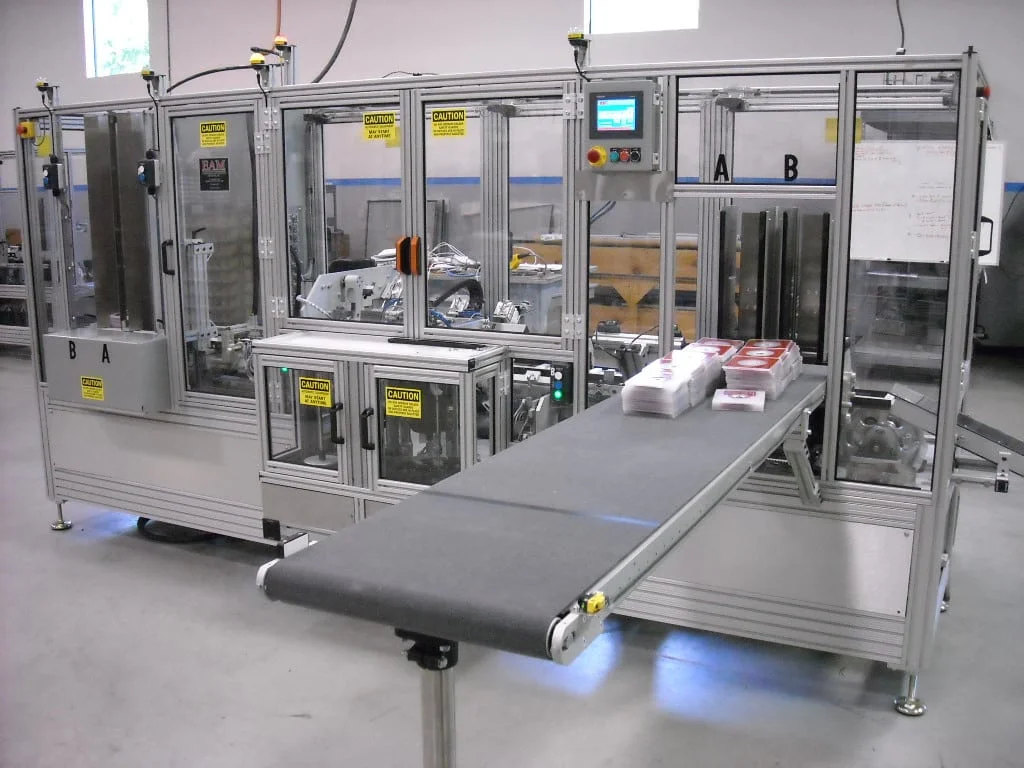
For manufacturers in the New England area — from Portland, ME, to Boston, MA — RFID systems provide a level of operational vision that was previously impossible. By automating data capture, EAM helps companies move away from manual logs and toward a truly digital factory.
Key Industry Use Cases
- Work-in-process (WIP) tracking: Tags attached to a chassis or sub-assembly allow managers to see exactly where an item is on the line, how long it has been there, and which technician worked on it.
- Inventory management: Instead of a weekend-long manual count, a warehouse worker can walk down an aisle with a handheld reader and update inventory levels in minutes with 99.9% accuracy.
- Asset tracking: Hospitals in Lewiston or Bangor use RFID to track expensive mobile equipment like ventilators and pumps, ensuring they are always ready for patient use and preventing theft.
- Logistics and shipping: Automated dock door readers verify that the right pallet is being loaded onto the right truck, triggering an alert if a mistake is made.
How Do RFID Systems Compare to Barcodes?
While barcodes are inexpensive, they require a human to find the code and point a laser at it. RFID systems offer several next-level advantages:
- No line of sight: Tags can be read through cardboard, plastic, and even some walls.
- Bulk reading: You can read 700+ tags per second. A barcode scanner reads one at a time.
- Read/write capability: You can update the data on an RFID tag as it moves through a process. A barcode is static once printed.
- Durability: RFID tags can be encased in rugged plastic to survive heat, chemicals, and pressure that would destroy a paper label.
RFID in Manufacturing and Supply Chain
The integration of RFID into the supply chain has created the Digital Product Passport. This allows for complete material traceability from the raw stage to the finished product. In 2011, basic tags cost about $0.09, but specialized tags for metal or gamma sterilization could cost up to $5. Despite the cost, the ROI is found in the reduction of labor and the elimination of shipping errors.
With the market expected to reach $16.23 billion by 2029, the trend is moving toward cold chain monitoring. Specialized RFID tags now include temperature sensors to ensure that pharmaceuticals or food products stay within safe limits during transit through New Hampshire or Maine.
Security, Privacy, and Implementation Challenges
As with any wireless technology, RFID systems face hurdles regarding data integrity and privacy. Because the signals travel through the air, they can theoretically be intercepted.
- Skimming and eavesdropping: Unauthorized readers could potentially skim data from a tag. To combat this, modern systems use data encryption and challenge-response authentication.
- Privacy concerns: In the retail sector, there have been concerns about tracking items after they leave the store. The industry responded with kill commands, which allow a retailer to permanently disable a tag at the point of sale.
- Shielding: Metal foil or specialized Faraday cages can block radio waves. While this is a challenge for reading tags near metal machinery, it is also a security feature. Many people now use RFID-blocking wallets to protect their credit cards.
For a deeper dive into these risks, the research on RFID privacy and security conducted by RSA Laboratories highlights the importance of rolling codes and cryptographic circuits in high-security applications.
Frequently Asked Questions About RFID Systems
What is the typical read range for different RFID frequencies?
The range varies widely. LF and HF systems are generally limited to less than 1 meter, often just 10 cm. UHF passive systems can reach up to 12 meters, or 40 feet, in ideal conditions. Active RFID systems can broadcast signals over 100 meters.
Can RFID tags be read through metal or water?
Standard UHF tags struggle with metal and water because metal reflects radio waves and water absorbs them. However, on-metal tags are specially designed with a spacer to allow reading on machinery. LF tags are the best choice if the item is submerged or contains a high volume of liquid.
What are the primary costs associated with implementing an RFID system?
Costs are split into two categories: fixed and recurring. Fixed costs include readers, antennas, and middleware. Recurring costs are the tags themselves. While a paper RFID label might be cheap, a ruggedized tag for a New England manufacturing floor might cost a few dollars. The true cost, however, should always be weighed against the labor savings and error reduction.
Ready to Build a Smarter RFID System?
The future of RFID systems is bright, moving toward even greater integration with the Internet of Things (IoT) and the development of chipless RFID, which uses unique material signatures instead of a silicon chip.
At EAM (Engineered Automation of Maine), we understand that every manufacturing environment is different. Whether you are in Biddeford, ME, or Manchester, NH, your facility has unique challenges — from metal interference to high-speed throughput requirements. For over 30 years, EAM has been the expert in custom automation systems, helping businesses across New England implement efficiency-driven solutions.
By combining our expertise in custom machinery with advanced RFID integration, EAM ensures your operation is not just tracking assets — it is gaining the real-time intelligence needed to compete in a global market. If you are ready to see how a tailored RFID solution can transform your floor, Engineered Automation of Maine is here to design the path forward.