
Why High-Speed Card Feeders Are a Game-Changer for Modern Production Lines

High-speed card feeders are automated machines that pull individual cards from a stack and deliver them precisely to downstream equipment — think printers, labelers, packagers, and inspection systems — without manual handling. This technology is a cornerstone of modern industrial automation.
If you’re looking for the right feeder fast, here’s what you need to know:
Top high-speed card feeder capabilities:
- Precision Automation: Handling variable card sizes with high accuracy, such as the EAM Cooper Card Feeder which reaches 5,500 in/min.
- High-Volume Throughput: Processing tens of thousands of pieces per hour for mailing and postcards.
- Friction Feeding: Ideal for batch counting and standard materials at high linear speeds.
- Rotary Pick & Place: Best for high-value items like gift cards, game cards, and prepaid cards.
Manual card feeding slows everything down. It introduces errors, bottlenecks your line, and burns labor hours on a task that machines do better — faster and more consistently.
Modern production demands more. Whether you’re running financial cards, gift cards, RFID cards, or blister packs, the right high-speed feeder can dramatically increase throughput and reduce costly mistakes.
EAM (Engineered Automation of Maine) has spent years helping manufacturers find and implement the right card feeding solutions for complex, high-volume lines. This guide breaks down the top options on the market so you can make a smart, informed purchase decision.
Understanding the Mechanics of High-speed Card Feeders
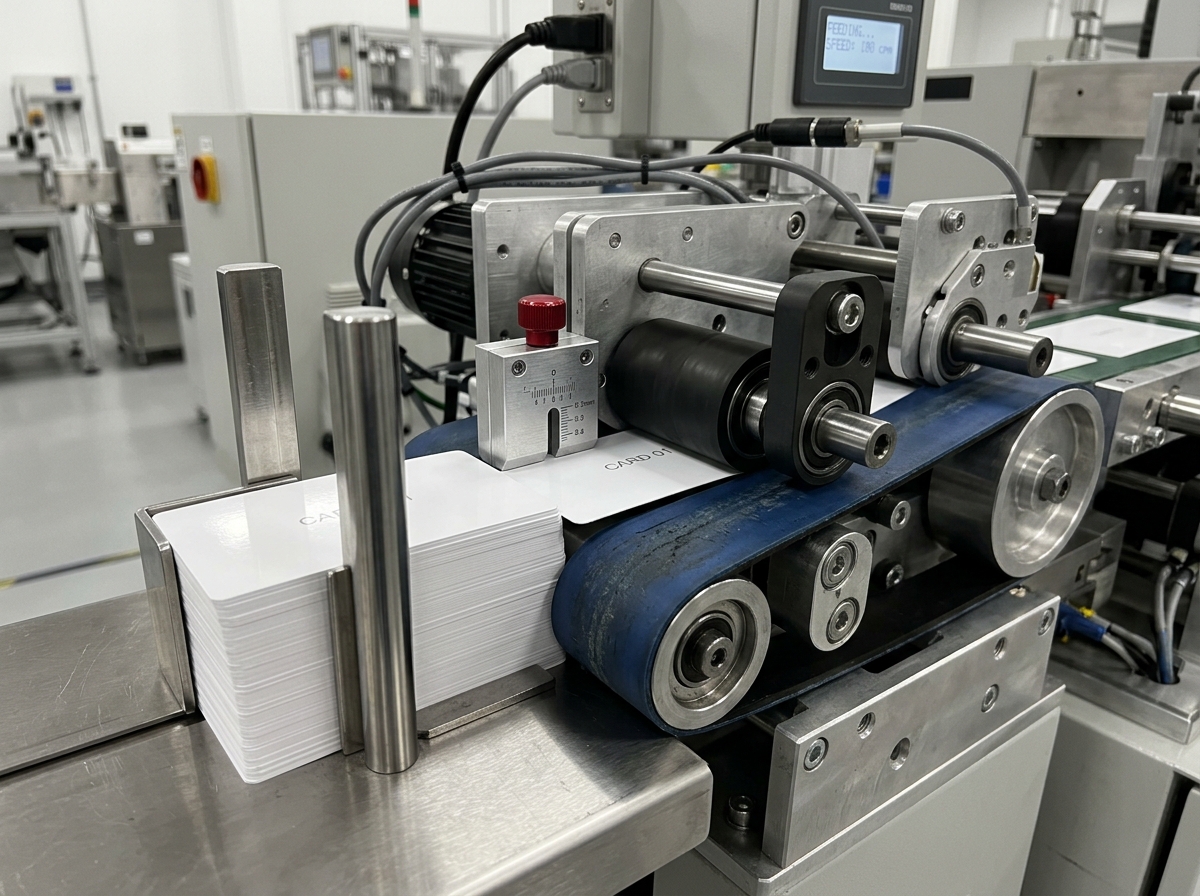
To the untrained eye, a card feeder looks like it’s just tossing paper or plastic around. In reality, it is a choreographed dance of physics and timing. High-speed card feeders function by isolating a single item from a vertical or slanted stack and accelerating it onto a conveyor or into a secondary machine.
There are several primary ways these machines achieve separation:
- Friction Feeding: This is the most common method. High-friction belts or rollers grab the bottom card of a stack. A “gate” or separator is set just high enough to let one card through while holding back the rest. This method is used to handle everything from envelopes to die-cuts.
- Vacuum Technology: Instead of relying solely on friction, vacuum feeders use suction cups or perforated belts to “suck” the card away from the stack. This is ideal for glossy or delicate materials where friction might cause scuffing.
- Rotary Pick & Place: These systems use a rotating arm with suction heads to pick a card and “place” it precisely. This is the gold standard for high-value items like gift cards or SIM cards where placement accuracy is more important than raw linear speed.
- Positive Feed Mechanism: EAM utilizes a sophisticated positive feed system in its Cooper Card Feeder. This involves an active stack lifter and vacuum takeaway. By actively managing the stack height and using vacuum force, the machine virtually eliminates misfeeds and double-feeds.
Optimizing Throughput with High-Speed Card Feeders
When we talk about “making your head spin,” we aren’t kidding about the numbers. The primary goal of investing in these systems is to remove the human bottleneck.
Linear Speed and Volume
The speed of a feeder is usually measured in two ways: linear speed (how fast the belt moves) and throughput (how many pieces it actually spits out per hour).
- The EAM Cooper Card Feeder hits a staggering maximum linear speed of 5,500 inches per minute (139 meters per minute).
- In terms of raw volume, professional-grade feeders can process up to 40,000 pieces per hour depending on the product dimensions.
- High-performance units often reach speeds of 750 feet per minute, making them powerhouses for continuous feed environments.
The Role of Servo Technology
Why are modern feeders so much faster than those from twenty years ago? The secret is Servo technology. Unlike old-school AC motors that are either “on” or “off,” servo motors allow for precise acceleration and deceleration. This means the feeder can “ramp up” to top speed instantly and stop on a dime for batch counting. This precision reduces the “cycle time”—the gap between one card and the next—allowing for the dense throughput required in modern packaging lines.
Seamless Integration of High-Speed Card Feeders
A feeder is rarely a standalone island. It is usually the “head” of a much larger body. For a production line in New England to run efficiently, the feeder must “talk” to the rest of the equipment.
- Inkjet Coding and Labeling: Many feeders are integrated with industrial inkjets for variable data printing (like expiration dates or serial numbers). The feeder must provide a steady, vibration-free stream of cards so the printer can hit its mark.
- Auxiliary Handshaking: High-end systems from EAM include auxiliary handshaking capabilities. This allows the feeder to synchronize with barcode readers or inspection cameras. If a camera detects a bad print, it can tell the feeder to stop or trigger a reject gate.
- Encoder and Trigger Outputs: To ensure a labeler hits the exact center of a card, the feeder uses an encoder to track the exact position of the belt. This data is shared with the labeling system to ensure perfect alignment every single time.
Key Features for Professional Feeding Systems
If you are in the market for high-speed card feeders, you shouldn’t just look at the speed dial. Professional-grade systems offer features that prevent “headaches” down the line.
- Card Size Compatibility: You want a machine that can grow with you. The EAM Cooper, for instance, handles a massive range—from tiny 3″ x 3″ cards up to large 18″ x 18″ sheets.
- OIT Touchscreens: Modern Operator Interface Terminals (OIT) make setup a breeze. Instead of turning manual knobs, operators can save “recipes” for different card types, adjusting speeds and batch counts with a tap.
- Error Detection and Jam Prevention: Advanced separation technologies eliminate high-friction nip points, which are a primary cause of jams. Modern systems also feature “missing product” detection to ensure your packaging never goes out empty.
- Batch Counting: Many industries require cards to be delivered in specific sets (e.g., “feed 10 cards, then pause”). Advanced feeders can handle batch counts up to 9,999 pieces with perfect accuracy.
Versatile Material Handling and Industry Applications
Not all cards are created equal. A feeder that works for a paper business card might fail miserably when trying to handle a thick, static-prone plastic credit card.
Material Compatibility
- Plastic Cards: Financial cards, ID badges, and loyalty cards require non-marring feeders that won’t scratch the surface.
- Blister Packs: These are often uneven in thickness. High-end feeders use “auto gating” to adjust to varying thicknesses on the fly.
- Folded Leaflets: Thicker, “springy” items like pharmaceutical inserts require high-torque friction feeders that can compress the product as it passes through the gate.
Industry Comparison Table: Friction vs. Vacuum
| Feature | Friction Feeders | Vacuum Feeders |
|---|---|---|
| Best For | Porous materials, paper, cardstock | Glossy, non-porous, delicate surfaces |
| Speed | Extremely high linear speeds | Moderate to High |
| Maintenance | Requires belt replacement | Requires pump/filter maintenance |
| Product Variety | Handles varying thicknesses well | Best for flat, uniform products |
Maintenance and ROI: The Long-term Value of Automation
Investing in high-speed card feeders is a capital expense, but the Return on Investment (ROI) is often realized in months, not years.
Durability and Construction
In the demanding manufacturing environments of Maine and Massachusetts, “flimsy” equipment doesn’t last. Look for feeders built with extruded aluminum floor stands and heavy-duty steel components. EAM focuses on robust construction to ensure their machines can run 24/7 without shaking themselves apart.
Labor Savings and Accuracy
The most obvious ROI comes from labor. One high-speed feeder can replace three or four manual loaders. Furthermore, machines don’t get tired. They don’t accidentally put 11 cards in a box meant for 10. By eliminating “over-fills” and “under-fills,” you save on both material costs and customer complaints.
Tool-less Adjustments
Time spent adjusting a machine is time spent not producing. Professional feeders feature tool-less “quick make-ready” adjustments. This allows an operator to switch from a CR80 gift card to a large blister card in under two minutes.
Frequently Asked Questions about Card Feeders
What is the difference between friction and vacuum feeders?
Friction feeders use moving belts to “drag” the card into the system, which is great for most paper and cardstock. Vacuum feeders use air suction to lift and move the card, which is better for very thin, very thick, or highly “slippery” plastic materials that might slide under a friction belt.
How do high-speed feeders handle different card thicknesses?
Most professional feeders use an adjustable “gate.” This is a gap that you set to be roughly 1.5 times the thickness of your card. Advanced models, like those from EAM, use “positive feed” or “auto-gating” mechanisms that can handle slight variations in thickness without needing a manual reset.
Can these systems integrate with existing inkjet printers?
Absolutely. This is one of their most common uses. High-speed feeders act as the “transport” system. They provide a steady, timed flow of cards, while an encoder tells the inkjet printer exactly when to fire. EAM often customizes these setups with mounting brackets for specific printer brands.
Ready to Upgrade Your Production Line?
Whether you are based in Biddeford, ME, or Boston, MA, the pressure to increase production efficiency is higher than ever. High-speed card feeders are no longer a luxury; they are a necessity for any manufacturing operation looking to stay competitive. From the raw speed of friction feeders to the surgical precision of rotary pick-and-place systems, there is a solution for every material and every budget.
At EAM (Engineered Automation of Maine), we’ve spent over 30 years perfecting the art of the “perfect feed.” We don’t just sell machines; we design custom automation workflows that solve your specific bottlenecks. If you’re tired of manual feeding holding your production line back, it’s time to look at a system that can keep up with your ambitions.