
Why Apparel Anti-Theft Tagging Systems Are Essential for Retail Loss Prevention

Apparel anti-theft tagging systems are the backbone of retail loss prevention — and choosing the right one can mean the difference between shrink that bleeds your margins and a store that runs tight.
Here’s a quick overview of the main system types to match your needs:
| System Type | Best For | Key Benefit |
|---|---|---|
| AM 58kHz Hard Tags | High-value apparel, general retail | High detection rate, low false alarms |
| RF 8.2MHz Labels | Volume garment tagging | Low cost, fast to apply |
| RFID Tags (UHF) | Inventory + loss prevention | Item-level tracking, self-checkout ready |
| Dual-Technology Labels | Ambitious retailers | Combines EAS alarm + RFID tracking |
| Ink/Benefit Denial Tags | High-theft, high-resale items | Destroys resale value on removal |
| Sew-In / Fabric-Integrated Tags | Premium and wash-intensive apparel | Permanent, wash-durable, discreet |
| Smart Self-Detaching Tags | Modern self-checkout environments | Friction-free shopping experience |
Retail shrink is a serious problem for stores of all sizes. Shoplifting, internal theft, and vendor fraud all chip away at margins — and apparel is one of the highest-shrink categories in retail.
The good news? Today’s tagging technology has advanced far beyond the simple hard tag on a lanyard. From sew-in RFID labels that survive 100+ wash cycles to smart tags that self-detach at the point of sale, there are purpose-built solutions for nearly every garment type and retail environment.
This guide breaks down every major category — so you can find the right fit fast.
Core Technologies in Apparel Anti-Theft Tagging Systems
When you walk into a clothing store in Boston or Portland, you likely pass through two upright pedestals at the entrance. These are the “ears” of the operation, listening for the specific frequency emitted by a security tag. The two primary languages these systems speak are Acousto-Magnetic (AM) and Radio Frequency (RF).
Acousto-Magnetic (AM) 58kHz
AM systems operate at 58kHz. They are the heavy lifters of the industry. Because the signal is highly resistant to interference from metal (like shopping carts or foil-lined “booster bags”), they are ideal for high-end boutiques and large department stores alike. AM tags are typically “hard tags” — those plastic shells that require a powerful magnet to remove.
Radio Frequency (RF) 8.2MHz
RF is the most common technology globally. Operating at 8.2MHz, it is generally more cost-effective than AM. RF is famous for its “soft labels” — those flat, paper-thin stickers with a circuit on the back often found on hangtags. While RF is great for high-volume tagging, it can be more sensitive to metal interference compared to its AM cousin.
RFID: The Intelligent Upgrade
Radio Frequency Identification (RFID) is the modern gold standard. Unlike traditional EAS (Electronic Article Surveillance) which simply says “Something is leaving the store,” RFID says “A size medium, blue cashmere sweater with SKU #12345 is leaving the store.” This item-level intelligence transforms security into a data-gathering powerhouse.
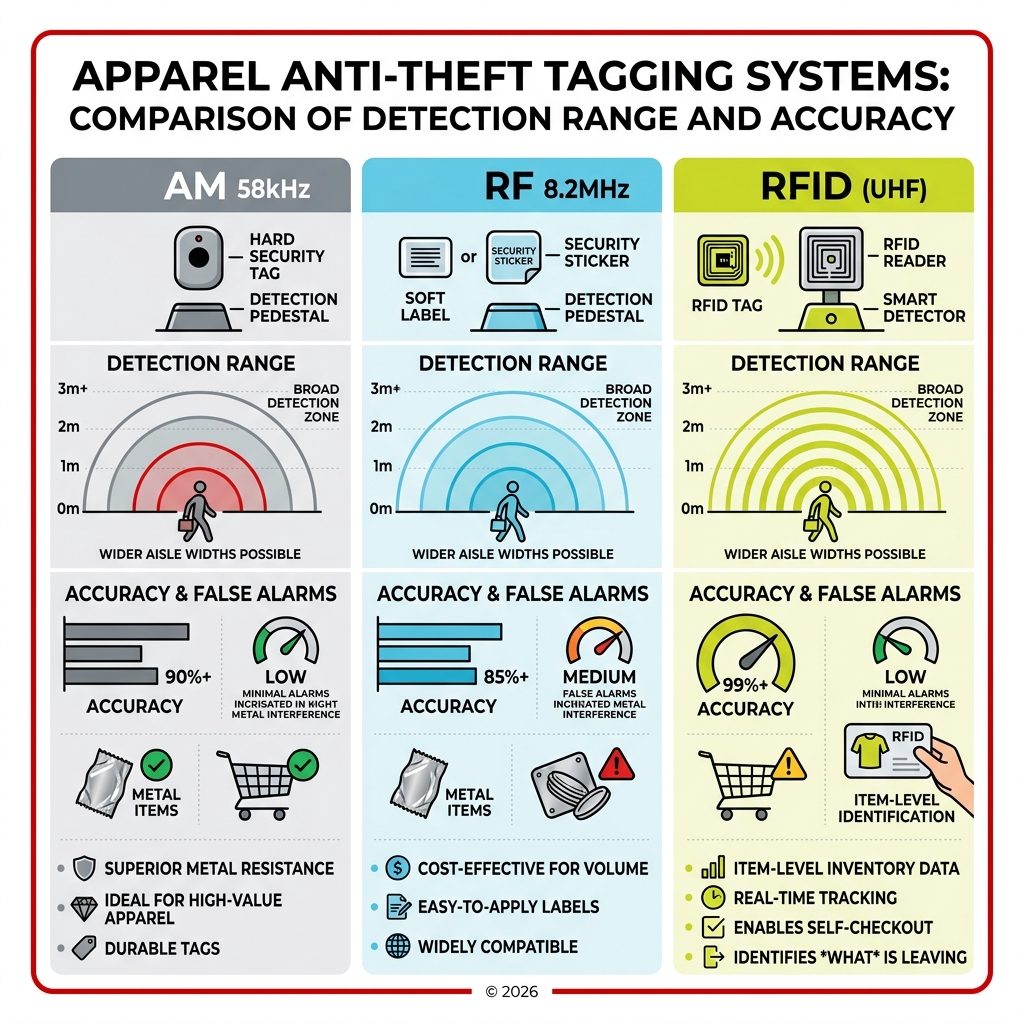
Traditional EAS vs. Modern RFID Apparel Anti-Theft Tagging Systems
The shift from traditional EAS to RFID is like moving from a basic car alarm to a GPS-tracked smart vehicle. While traditional systems focus solely on shoplifting deterrence, modern apparel anti-theft tagging systems using RFID focus on the entire lifecycle of the garment.
Item-Level Tracking and Supply Chain Visibility
With RFID, a retailer in Manchester or Worcester can track a shipment from the factory floor to the stockroom and finally to the sales floor. This visibility prevents “phantom shrink” — where items are lost in the supply chain or miscounted during inventory. Research shows that RFID systems can achieve up to 99% inventory accuracy, which is a massive jump from the 65-70% seen in non-RFID environments.
Dual-Technology Labels
Why choose one when you can have both? Dual-technology labels combine an RFID chip for inventory management with an AM or RF circuit for traditional loss prevention. This allows retailers to enjoy the benefits of high-speed inventory counts while still utilizing their existing pedestal systems at the front door. It is the ultimate “bridge” technology for stores looking to modernize without a total hardware overhaul.
Specialized Hard Tags for High-Theft Items
Standard garments are easy to tag, but what about the oddballs? High-theft items often require specialized shapes and locking mechanisms to ensure the tag stays put without damaging the merchandise.
- Pencil Tags: These are the sleek, thin workhorses of the industry. They are lightweight and perfect for delicate fabrics like silk or lace where a heavy tag might cause sagging or tearing.
- Bell Tags: Named for their shape, these are much harder for a thief to get a grip on with a pair of pliers, making them a top choice for high-value jackets and coats.
- Baseball Bat and Golf Club Tags: Yes, people try to walk out with sports equipment. These specialized tags use adjustable cables or specialized grips to secure items that don’t have a natural place for a pin.
- Eyewear Protection: Small, discreet tags like the OptiLok or JewelLok are designed to sit on the arm of glasses or on jewelry without interfering with the customer’s ability to try the item on.
High-Security Hard Tags and Benefit Denial Solutions
Sometimes, an alarm isn’t enough. Professional shoplifters often ignore the “beep” and keep running. This is where “benefit denial” comes in. If a thief manages to get the item out of the store, benefit denial technology ensures they can’t wear it, sell it, or profit from it.
Ink Tags
The classic ink tag contains glass or plastic vials filled with permanent, pressurized dye. If someone tries to pry the tag off without the proper detacher, the vials burst, ruining the garment and the thief’s day. It is one of the most effective visual deterrents available.
Active Benefit Denial and Glue Fusion
Newer concepts, such as the FuzeTag, take this a step further. Instead of just ink, some systems use a melted glue fusion. If the tag is illicitly removed, it releases a colored, heated glue that fuses into the fabric fibers. This doesn’t just stain the item; it physically alters the texture, making it impossible to “clean” for resale on the black market.
Removal Methods: Magnetic and Power Detachers
The security of a tag is only as good as its lock.
- Standard Magnetic Detachers: Used for basic tags.
- Superlock Detachers: Require a much stronger magnetic pull, making it harder for thieves to use “pocket magnets” they might bring into the store.
- Power Detachers: These are electric units that use an encrypted signal or motorized mechanism to release the tag, offering the highest level of security against unauthorized removal.
Discreet and Sustainable Tagging for Premium Apparel
For luxury brands in Boston’s Back Bay or boutiques in Portland’s Old Port, a giant plastic tag can ruin the “vibe.” Discreet solutions allow for high security without the bulky hardware.
Pocket Tags and Sew-In Labels
Discreet RFID solutions like pocket tags are fabric labels sewn directly into the lining, pocket, or seam of a garment. These are virtually invisible to the customer but fully detectable by overhead sensors.
Fabric-Integrated and Wash-Durable RFID
Innovations like AD TexTrace have changed the game for long-term tracking. These are RFID tags woven into the brand’s own labels.
- Durability: Some versions are tested to withstand over 100 home wash and dry cycles.
- Denim Specific: There are even “Denim PFL” (Printed Fabric Labels) designed to survive the aggressive stone-washing and acid treatments used during jeans manufacturing.
- Authentication: Because these tags stay with the garment for its entire life, they are excellent for the resale market, allowing buyers to verify the authenticity of a high-end bag or coat via a quick smartphone scan.
Advanced Detection and Organized Retail Crime (ORC) Tools
Organized Retail Crime is a sophisticated threat that requires sophisticated tools. Modern detection systems do more than just alarm; they provide a full suite of analytics.
Metal-Foil and Jammer Detection
Professional thieves often use “booster bags” — shopping bags lined with several layers of aluminum foil to shield tags from detection. Advanced pedestals, like the Sensormatic Synergy series, include metal-foil detection that alerts staff the moment a shielded bag enters the store. Similarly, jammer detection can identify devices meant to “drown out” the EAS frequency.
Concealed and Discreet Systems
Not every store wants pedestals. Concealed floor systems (recessed into the ground) or overhead sensors provide a wide, open entrance while maintaining 360-degree protection. This is perfect for high-traffic “open mall” storefronts where a physical barrier isn’t desired.
Traffic Analytics and People Counting
Modern apparel anti-theft tagging systems are often integrated with people-counting sensors. By comparing the number of people entering the store with the number of alarm events and actual sales, retailers can calculate their “conversion rate” and pinpoint exactly when and where they are most vulnerable to theft.
Future Trends in Apparel Anti-Theft Tagging Systems
The future of retail is “frictionless.” As self-checkout and “Scan & Go” technology become the norm, tagging systems must keep up.
Smart Self-Detaching Tags
Imagine a tag that stays on the garment until the customer pays via an app or at a kiosk. Once the transaction is verified, the tag automatically unlocks itself. The rapitag Fashion Tag is a prime example of this, allowing for a seamless shopper experience where no employee assistance is needed for tag removal.
Integration with Automation
As manufacturing becomes more automated, “source tagging” is becoming the standard. This is where tags are applied at the factory rather than in the store. EAM (Engineered Automation of Maine) specializes in creating the custom automation equipment that makes this possible, ensuring that tags are applied with high precision and speed before the clothes even reach the retail floor.
Frequently Asked Questions About Apparel Security
How do RFID tags improve inventory management?
RFID allows for “simultaneous reading.” Instead of scanning every barcode one by one, an employee can wave a handheld reader near a rack of 100 shirts and count them all in seconds. This leads to near-perfect stock replenishment and ensures that if a customer sees an item online, it’s actually in the store when they arrive.
Can security tags survive industrial washing?
Yes. Specialized heat-seal and sew-in RFID tags are designed specifically for the laundry industry and high-end fashion. Some are rated for over 100 wash cycles and are resistant to the chemicals used in dry cleaning, making them permanent fixtures of the garment.
The Bottom Line for Smarter Apparel Loss Prevention
Choosing the right apparel anti-theft tagging systems is about balancing security, aesthetics, and efficiency. Whether you are a small boutique in Conway, NH, or a massive distribution center in Lowell, MA, the technology exists to protect your bottom line without slowing down your sales.
At EAM (Engineered Automation of Maine), we understand that every retail and manufacturing environment is unique. With over 30 years of experience, EAM designs and manufactures the custom automation equipment needed to integrate these security solutions into your workflow seamlessly. From high-speed labeling to custom assembly systems, we help businesses across New England stay competitive and secure.