
What Is a Pick and Place Industrial Robot (And Why It Matters for Manufacturers)
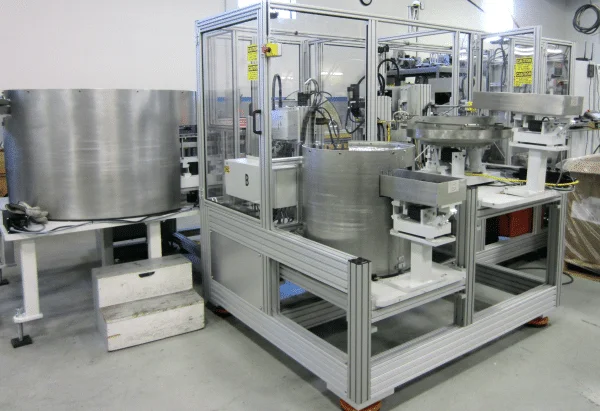
A pick and place industrial robot is an automated machine that lifts objects from one location and moves them to another — replacing slow, repetitive manual labor with consistent, high-speed precision.
Pick and place automation isn’t new. The first industrial robot — the Unimate — was introduced back in 1961, moving die castings on automotive assembly lines. But today’s systems are a different beast entirely.
Modern pick and place robots are incredibly fast and precise. Some delta robots complete a full pick cycle in under 0.30 seconds. Vision systems identify objects by shape, color, and position in real time. Software can coordinate dozens of robots simultaneously, processing thousands of parts per minute.
For manufacturing managers dealing with slow production lines, inconsistent output, or mounting labor costs, these systems represent one of the most direct paths to measurable improvement.
The challenge isn’t whether pick and place robots work — it’s knowing which type fits your application, your environment, and your throughput goals. That’s exactly what this guide covers.
The Different Types of Pick and Place Industrial Robots
Choosing the right pick and place industrial robot is a bit like choosing a car; you wouldn’t use a Formula 1 racer to move a couch, and you wouldn’t use a semi-truck to win a drag race. In automation, the “vehicle” is defined by its mechanical structure.
| Robot Type | Primary Strength | Best For | Payload Range |
|---|---|---|---|
| Delta | Extreme Speed | Food, Small Parts | 1kg – 8kg |
| SCARA | High Speed & Precision | Electronics, Assembly | 3kg – 20kg |
| Cartesian | Reach & Scalability | Large Enclosures, Palletizing | High (Scalable) |
| 6-Axis | Flexibility | Complex Orientations | 3kg – 1,000kg+ |
| Cobot | Safety & Ease of Use | Small Shops, Shared Spaces | 3kg – 30kg |
Delta Robots (Parallel Kinematics)
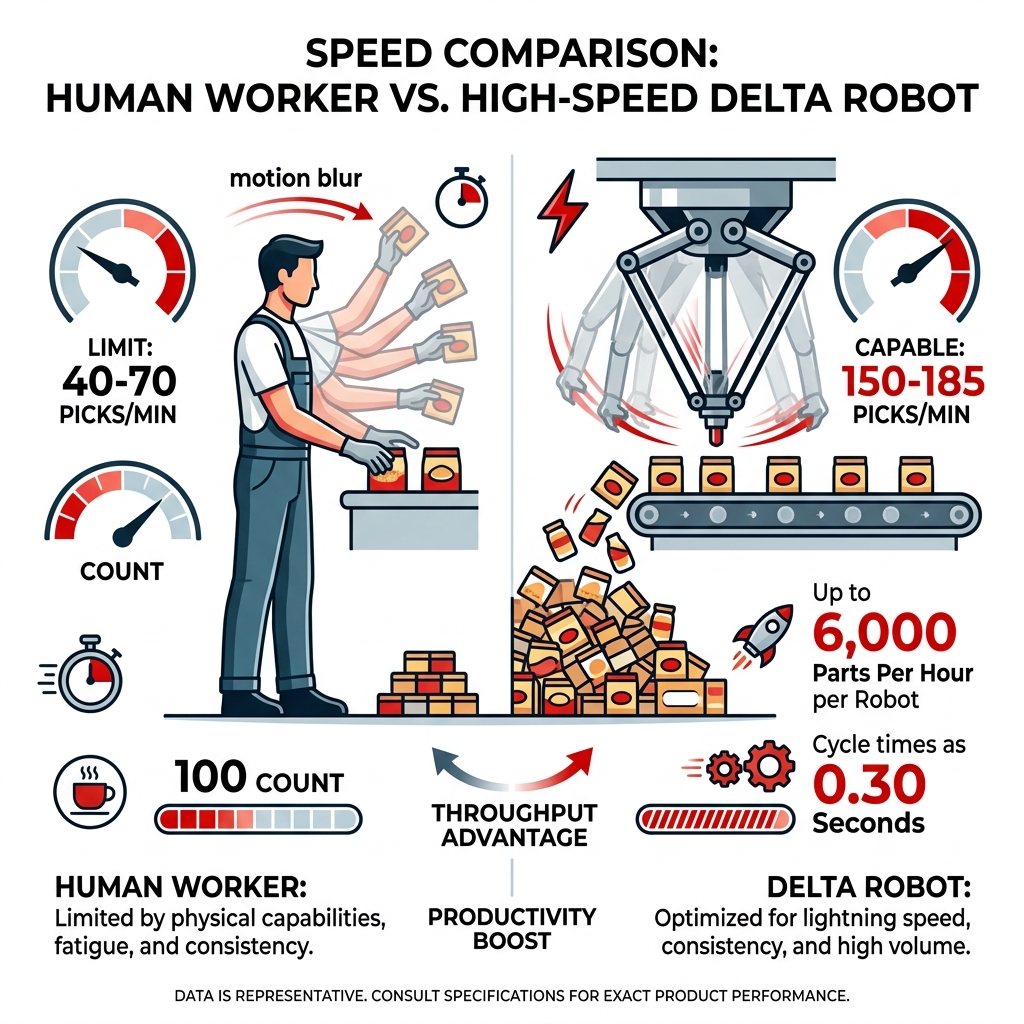
Often called “spider robots,” delta robots are mounted above a conveyor. They use three or four slender arms connected to a single base. Because the heavy motors are located in the stationary base rather than the moving arms, the robot can move with lightning speed. These are the undisputed kings of high-volume picking, often capable of moving 150 to 185 parts per minute.
SCARA Robots
The SCARA (Selective Compliance Assembly Robot Arm) is a horizontal-motion specialist. It mimics the movement of a human arm but is restricted to a specific plane. This makes it incredibly rigid and fast for “top-down” assembly tasks, like inserting a processor into a motherboard or capping a bottle.
Cartesian Robots
Named after the Cartesian coordinate system, these robots move along three linear axes: X, Y, and Z. Think of them like a giant overhead gantry. While they aren’t as “flashy” as delta robots, they are incredibly reliable for tasks requiring high precision over a large area, such as CNC loading or large-scale part transfer.
6-Axis Articulated Arms
If you need a robot that can “reach around” an object or flip a part upside down, the 6-axis robot is your best friend. These offer the most human-like range of motion. While traditionally slower than deltas for small parts, modern high-speed versions can still handle significant throughput while offering unmatched flexibility.
Collaborative Robots (Cobots)
Cobots are designed to work alongside humans without safety cages. They feature built-in sensors that stop the robot instantly if they touch a person. For a manufacturer in Manchester, NH or Worcester, MA looking to automate a small station without reconfiguring the whole floor, a cobot is often the most accessible entry point.
High-Speed Delta and SCARA Systems
When we talk about “high speed” in the context of a pick and place industrial robot, we aren’t just talking about moving fast; we’re talking about cycle times measured in fractions of a second.
The Speed Demons: Delta Systems
In high-volume industries like food processing or cosmetics, speed is everything. Leading delta models can achieve cycle times as low as 0.30 seconds. To put that in perspective, that’s faster than the blink of a human eye.
- Throughput: A single 4-axis delta robot can move between 4,000 and 6,000 parts per hour.
- Coordination: Modern software allows multiple robots to work on the same line, synchronizing their movements to pick up to 2,000 items per minute without colliding.
Precision Specialists: SCARA Systems
SCARA robots are the go-to for electronics assembly in regions like the tech hubs around Boston, MA. They excel at “pick, move, press” cycles.
- Cycle Times: Top-tier SCARA robots can achieve cycle times of 0.36 seconds with a 500 mm reach.
- Accuracy: Because they are mechanically rigid in the vertical direction, they can press components into place with high force and sub-millimeter repeatability (often within ±0.01 mm).
Cartesian and Articulated Robots
Not every task requires 150 picks per minute. Sometimes, you need a pick and place industrial robot that can handle a 50lb box or reach across a six-foot workspace.
The Power of Cartesian Systems
Cartesian robots are the workhorses of the assembly world. Because they are built on linear rails, they can be scaled to almost any size. If you are a manufacturer in Lewiston, ME producing large-format goods, a Cartesian system allows you to cover a massive 3D workspace with extreme precision. They are particularly effective for:
- Palletizing: Moving finished goods from a conveyor to a shipping pallet.
- Machine Tending: Picking heavy raw materials and placing them into a CNC machine or injection molder.
The Versatility of Articulated Arms
6-axis robots are the “do-everything” standouts. While a delta robot is stuck looking down, a 6-axis arm can pick a part from a bin, rotate it to check a barcode, and then place it into a box at a 45-degree angle.
- Long Reach: Some models offer reaches of over 3 meters, making them ideal for large-scale assembly.
- Heavy Payloads: While deltas top out at a few kilograms, articulated arms can pick up entire engine blocks or car doors.
Core Components and Vision Technology
A pick and place industrial robot is more than just a metal arm; it is a complex ecosystem of hardware and software working in harmony.
- The Robotic Arm: The mechanical structure that provides the reach and payload capacity.
- The Controller: The “brain” of the system. It processes inputs from sensors and tells the motors exactly how much to turn.
- The Software: This is where the magic happens. Modern software allows for robot integration with existing factory systems, enabling robots to track moving conveyors in real-time.
- Movement Control: Advanced algorithms ensure the robot moves in the most efficient path possible, reducing wear and tear while maximizing speed.
End Effectors: The “Hands” of the Robot
The robot arm gets the tool to the right spot, but the end effector (or End-of-Arm Tooling – EOAT) does the actual work.
- Vacuum Grippers: The most common tool for pick and place. They use suction cups to lift flat or semi-porous objects. They are gentle enough for a potato chip but strong enough for a car windshield.
- Mechanical Clamps: These use “fingers” to grasp objects. They are ideal for parts that don’t have a flat surface for a vacuum.
- Magnetic Tools: Perfect for metal parts in automotive or machining applications.
- Adhesive Grippers: Used for delicate fabrics or items that might be damaged by traditional pressure.
Vision Systems and Sensors: The “Eyes”
Without vision, a robot is “blind” and can only pick items from a fixed, known location. With vision, the robot becomes intelligent.
- 2D Vision: A camera takes a flat picture. The robot uses this to find the X and Y coordinates and the rotation of a part on a conveyor belt.
- 3D Bin Picking: Using 3D sensors, the robot can see depth. This allows it to reach into a messy bin of overlapping parts, identify the one on top, and pick it successfully.
- Force Sensors: These allow the robot to “feel.” If a part is stuck or requires a specific amount of pressure to snap into place, the force sensor tells the robot to adjust its strength.
Industrial Applications and High-Speed Tasks
In the manufacturing corridors of New England — from the seafood processors in Portland, ME to the electronics firms in Nashua, NH — pick and place industrial robot systems are transforming daily operations.
Primary Packaging and Food Handling
Food safety is a major driver for automation. Robots don’t get sick, they don’t need breaks, and they don’t carry bacteria.
- Case Study: A candy manufacturer might use a delta robot to sort chocolates into trays. The robot can use vision to identify “rejects” (broken pieces) and remove them before they ever reach the box.
- Hygiene: Many robots are now designed with “washdown” capabilities, allowing them to be sprayed with harsh chemicals to maintain a sterile environment.
Assembly and Kitting
In electronics and medical device manufacturing, robots are used to assemble tiny components that are too small for human fingers.
- Kitting: A robot can pick five different parts from five different bins and place them into a single “kit” for a customer.
- Precision: Scientific research on precise pick-and-place continues to push the boundaries of how these machines handle microscopic parts with zero errors.
Bin Picking and Sorting
Logistics and e-commerce warehouses use robots to sort thousands of unique SKUs. A robot can identify a bottle of shampoo, a box of detergent, and a bag of dog food, picking each one with the appropriate force and placing it into a shipping box.
Selecting a Pick and Place Industrial Robot for High-Speed Tasks
If you’re looking to upgrade your facility, you can browse our automation products to see the range of possibilities. But before you buy, you need to consider the “Big Four” specifications:
- Payload: This isn’t just the weight of your product; it’s the weight of the product plus the weight of the end effector. If your robot is rated for 3kg and your gripper weighs 1kg, you only have 2kg of “usable” payload.
- Reach: How far does the robot need to move? Remember to account for the “dead zone” directly under or behind the robot where it might not be able to reach efficiently.
- Repeatability: This is the robot’s ability to return to the exact same spot every time. For assembly, you might need ±0.02 mm. For palletizing boxes, ±0.5 mm is usually plenty.
- Cycle Time: How many parts per minute do you actually need? Over-speccing a robot for speed you don’t use is a waste of money, but under-speccing will create a bottleneck in your production.
Hygienic and Cleanroom Environments
For industries like pharmaceuticals and food processing, the environment is just as important as the task. A standard industrial robot might shed paint or leak oil — a disaster for a cleanroom in Boston or a food plant in Bangor.
The IP69K Standard
The “gold standard” for hygienic robots is the IP69K rating. This means the robot is completely dust-tight and can withstand high-pressure, high-temperature washdowns.
- Stainless Steel Design: Many hygienic robots use stainless steel instead of aluminum to prevent corrosion.
- Food-Grade Lubricants: These robots use NSF-H1 certified grease, which is safe for incidental contact with food.
- No “Nooks and Crannies”: Hygienic robots are designed with smooth, rounded surfaces so that bacteria have nowhere to hide.
Strategic Benefits and ROI
At the end of the day, an investment in a pick and place industrial robot has to make financial sense. For EAM customers in Maine and across New England, the return on investment (ROI) usually comes from three places:
1. Labor Shortage Relief
It is no secret that finding reliable labor for repetitive, “boring” tasks is harder than ever. Robots allow human workers to move into higher-value roles — like quality control or system management — while the robot handles the mind-numbing repetition.
2. Consistency and Quality
A human worker might get tired at 3:00 PM and start making mistakes. A robot performs the exact same way at 3:00 AM as it does at 8:00 AM. This reduces waste and ensures that every product leaving your facility meets the same high standard.
3. Increased Throughput
If a human can pick 20 parts per minute and a robot can pick 60, you have just tripled the capacity of that station. In many cases, EAM clients see their systems pay for themselves in less than 18 to 24 months through increased production alone.
Frequently Asked Questions
What is the difference between Delta and 6-axis robots?
The primary difference is speed versus flexibility. A delta robot is much faster (up to 185 CPM) but is generally limited to picking items from a flat conveyor and placing them on another flat surface. A 6-axis robot is slower but can rotate parts, reach into deep containers, and mount tools at various angles. Delta robots are almost always ceiling-mounted, while 6-axis robots can be floor, wall, or ceiling-mounted.
How do cobots differ from traditional industrial robots?
Safety is the main differentiator. Traditional robots require heavy steel fencing and light curtains to keep humans away. Cobots have “force-limiting” technology that allows them to bump into a person and stop immediately without causing injury. This makes them great for tight spaces, though they are generally slower and have lower payloads than their “industrial” cousins.
What maintenance is required for these systems?
Modern robots are surprisingly low-maintenance. Many delta robots use self-lubricating joints that can run for years without intervention. Typical maintenance includes:
- Software Updates: Keeping the “brain” current.
- Sensor Calibration: Ensuring the vision system stays accurate.
- End Effector Wear: Replacing suction cups or gripper pads as they wear down from contact with parts.
- Grease Checks: For non-self-lubricating models, periodic regreasing of the joints is required.
Ready to Improve Your Pick and Place Automation?
The world of manufacturing is moving faster than ever. Whether you are a small shop in Conway, NH or a massive production facility in Boston, MA, the pick and place industrial robot is no longer a luxury — it is a necessity for staying competitive.
At EAM (Engineered Automation of Maine), we have spent over 30 years perfecting the art of custom automation. We don’t just sell robots; we design integrated solutions that solve real-world problems. From custom labelers and conveyors to fully integrated robotic assembly cells, we bring efficiency to the heart of New England manufacturing.
If you are ready to eliminate bottlenecks, reduce labor headaches, and take your throughput to the next level, we are here to help. Our team specializes in taking the “complex” out of automation, providing you with a system that works from day one.
Ready to transform your production line? Contact EAM for a custom automation quote today and let’s build something efficient together.